

Hair Cloning for Hair Loss: Can Science Really Create New Hair Follicles?
- December 16, 2025
- 0 Likes
- 412 Views
- 0 Comments
Dermatalk.com | Evidence-based insights on skin & hair health
Hair loss is no longer just a cosmetic concern — it’s a confidence crisis searched by millions every single day. From celebrities to young adults noticing early thinning, everyone is asking the same question: Is there a real cure for baldness?
One futuristic answer keeps going viral across social media and science news — hair cloning. Headlines promise unlimited hair and an end to transplants forever.
But how much of this is real science, and how much is exaggerated hype? Here’s a clear, dermatologist‑approved breakdown for Dermatalk readers.
What Is Hair Cloning?
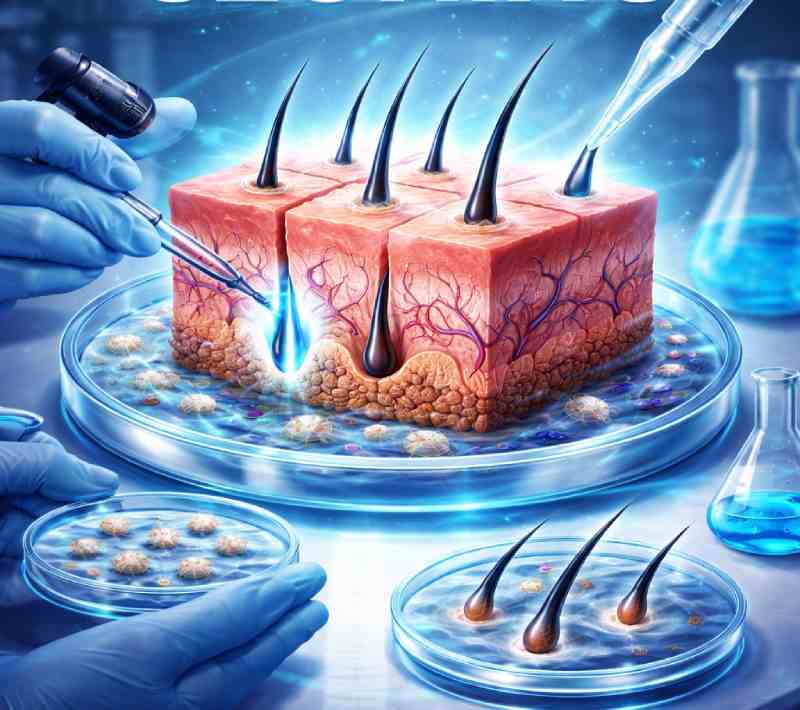
Hair cloning, medically referred to as hair follicle regeneration or hair multiplication, is an experimental technique aimed at creating new hair follicles in the scalp.
Unlike conventional hair transplantation — which relocates existing follicles from the donor area — hair cloning attempts to multiply hair-forming cells in a laboratory and reintroduce them to generate brand-new follicles.
In simple terms: instead of moving hair, scientists are trying to grow more hair.
How Does Hair Cloning Work?
Current research focuses on a three-step biological process:
- Cell Harvesting – A small sample of healthy hair follicle cells, especially dermal papilla cells, is taken from the patient.
- Laboratory Expansion – These cells are cultured and multiplied using advanced 3D techniques that mimic natural hair follicle development.
- Scalp Reintroduction – The expanded cells are injected back into thinning or bald areas to stimulate new follicle formation.
Animal studies have shown encouraging results, with newly formed follicles capable of producing real hair shafts.
Current Research Status: Where Are We Today?
✔ Successful creation of hair follicle organoids in laboratory settings
✔ Early human trials showing variable improvement in hair density
✔ Active research programs in Japan, the US, and Europe
❌ No FDA-approved or clinically established hair cloning treatment yet
At present, hair cloning remains experimental and confined to research trials.
Why Is Hair Cloning Not Available in Clinics Yet?
Despite promising breakthroughs, several challenges remain:
- Hair follicle cells may lose their hair-inducing ability after lab expansion
- Achieving natural hair direction, thickness, and density is complex
- Long-term safety, hair cycling, and durability must be proven
- Regulatory approval for cell-based therapies is rigorous
These hurdles must be resolved before hair cloning becomes a routine treatment.
When Can Patients Expect Hair Cloning?
Based on current scientific progress:
- Late 2020s: Advanced human clinical trials
- Early–mid 2030s: Possible limited clinical availability (if proven safe and effective)
Until then, evidence-based treatments remain the gold standard.
Dermatalk Verdict
Hair cloning is one of the most exciting developments in hair restoration science, offering hope for a future where donor hair limitations no longer exist.
However, Dermatalk emphasizes realistic expectations. For now, medical therapy, PRP, GFC and hair transplantation continue to be the most reliable solutions.
As research evolves, Dermatalk will keep you updated with science-backed insights — not hype.
FAQs
Is hair cloning available in Nepal or India?
No. Hair cloning is not commercially available anywhere in the world.
Is hair cloning a stem cell treatment?
Some techniques involve stem cells or follicle progenitor cells, but all remain experimental.
Can hair cloning permanently cure baldness?
Theoretically yes, but long-term human evidence is still lacking.
Is hair cloning better than hair transplant?
Potentially in the future, but currently hair transplant remains the most predictable option.
Reviewed by Dermatalk Editorial Team | Dermatologist-authored content


Leave Your Comment